
Explore our collection of resources developed by and for First Peoples with disability, their families and communities. Download booklets, flash cards, and other tools to support learning, advocacy, and community-led change.
Resources for Community
We have a range of informative and helpful resources to download.
Resources for ACCHOs & Partners
View our library of resources for ACCHOs, Partners and the sector.
Videos & Podcasts
Explore our growing library of community videos and listen to episodes of Yarning Disability, the FPDN podcast sharing powerful First Nations voices.
Document type
Filter
Individual Advocacy Brochure
Disability advocacy is acting, speaking or writing to promote, protect and defend the human rights of people and to support their voice to be heard. Individual Advocacy is a one-on-one journey with a designated Advocate who walks alongside to help prevent or address instances of discrimination, abuse, neglect or exploitation.
National Disability Footprint Community Summary 2022-2026
The National Disability Footprint (the Footprint) is a major investment in strengthening the First Peoples Disability Network (FPDN) as the national peak body of and for First Nations people with disability. Funded by the National Indigenous Australians Agency (NIAA), the Footprint was initially funded from 2022 to 2024, with funding extended to 2026.
Position Statement - Aged Care and Disability
Many First Nations people enter aged care because of disability-related support needs rather than age-related frailty. Early-onset dementia, acquired brain injury, stroke, sensory impairment and chronic disease contribute to aged care entry from age 50, decades before the age profile seen for non-Indigenous Australians. The aged care system is not structured to respond to this pattern of need.
FPDN Position Statement - Ageing and Disability
Older First Nations people with disability experience a major policy and service gap at the intersection of disability, ageing, health and housing. Nearly half of First Nations people aged 55 and over live with disability (Avery & ABS 2025). No national dataset adequately connects Indigeneity, disability and age, and current systems respond to only one part of this experience at a time: a disability system with an age cutoff, an aged care system with limited disability competence, a health system that is often not culturally safe, and a housing system that is frequently inaccessible.
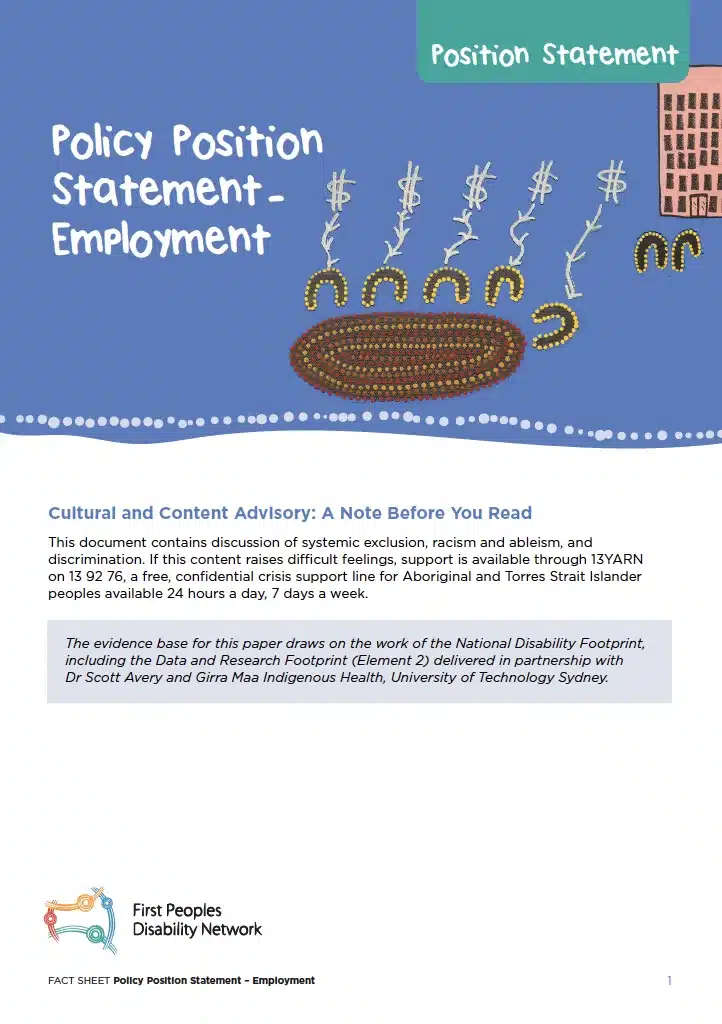
Policy Position Statement - Employment
This policy position statement identifies the evidence and policy reforms required to improve employment outcomes for First Nations people with disability. First Nations people with disability have the lowest employment rate of any population group in Australia, but employment policy and programs continue to address Indigeneity and disability separately. As a result, this cohort is not consistently recognised in data, targets, or service design.
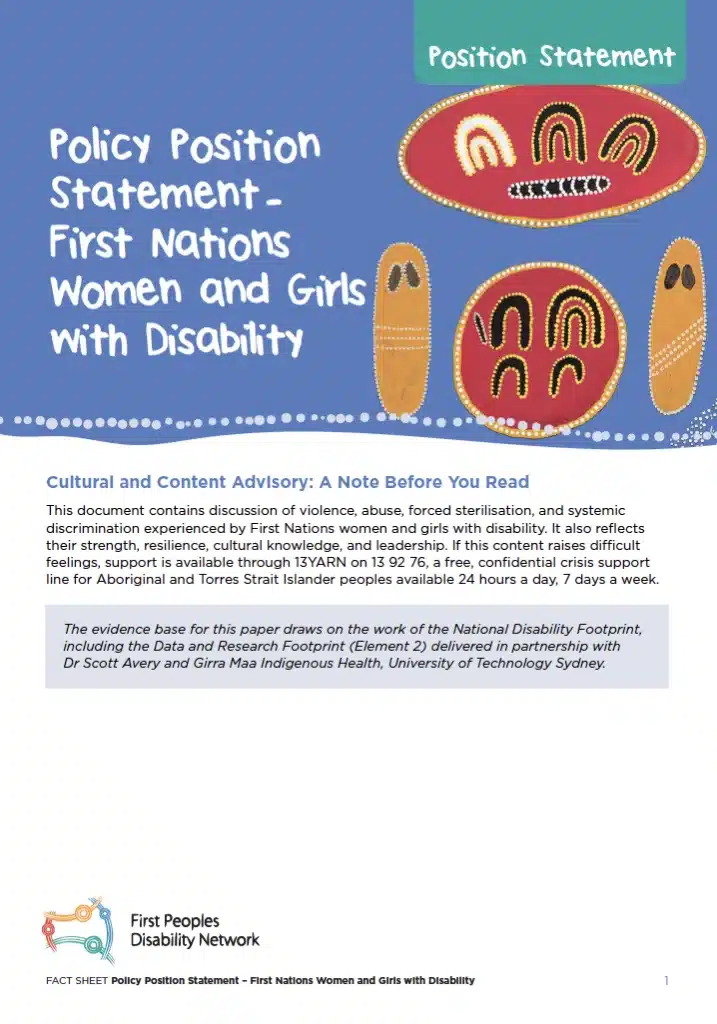
Policy Position Statement - First Nations Women and Girls with Disability
First Nations women and girls with disability experience compounding structural disadvantage at the intersection of race, gender, and disability. Yet, First Nations women and girls with disability are not adequately recognised in Australia’s data systems, policy frameworks, or service responses. Approximately one in four Aboriginal and Torres Strait Islander women and girls has disability (ABS & Avery, 2025; AHRC, 2024).
Community
Select from our range of informative and helpful resources to download.
Individual Advocacy Brochure
Disability advocacy is acting, speaking or writing to promote, protect and defend the human rights of people and to support their voice to be heard. Individual Advocacy is a one-on-one journey with a designated Advocate who walks alongside to help prevent or address instances of discrimination, abuse, neglect or exploitation.
National Disability Footprint Community Summary 2022-2026
The National Disability Footprint (the Footprint) is a major investment in strengthening the First Peoples Disability Network (FPDN) as the national peak body of and for First Nations people with disability. Funded by the National Indigenous Australians Agency (NIAA), the Footprint was initially funded from 2022 to 2024, with funding extended to 2026.

Know your Human Rights – With video links

Feedback & Complaints
We encourage clients to provide feedback or complaints, as we see this as an opportunity to grow and improve our services.


FASD Factsheet – for Teachers
Fetal Alcohol Spectrum Disorder (FASD) is a term used to describe a range of lifelong physical, cognitive, and behavioural impairments that can occur in a person whose mother drank alcohol during pregnancy. Information regarding the Justice System.

FASD Factsheet – Justice System
Fetal Alcohol Spectrum Disorder (FASD) is a term used to describe a range of lifelong physical, cognitive, and behavioural impairments that can occur in a person whose mother drank alcohol during pregnancy. Information regarding the Justice System.

FASD Factsheet regarding Juvenile Justice
Fetal Alcohol Spectrum Disorder (FASD) is a lifelong condition that is caused by prenatal exposure to alcohol – Information regarding Juvenile Justice.

FASD Fact Sheet for Employers
Fetal Alcohol Spectrum Disorder (FASD) is a group of conditions caused by prenatal alcohol exposure – Information for Employers.

FASD Strategies for Classroom Settings
Managing Young People with FASD in Australia. FASD is a brain-based disability that can affect a person’s ability to learn, communicate, and regulate their behaviour – Here are some Strategies for Classroom Settings.

Human Rights Flashcards
The United Nations Convention on the Rights of Persons with Disabilities (UNCRPD) is a type of treaty or agreement between countries that requires governments around the world, including the Australian government, to work to ensure the rights of people with disability are recognised, respected, protected and fulfilled. The United Nations has written a list of rights for people with a disability called Articles. These are YOUR rights.

Human Rights Factsheet
Human rights are important knowledge that Aboriginal and Torres Strait Islander people living with disabilities, their families and communities need to know and use in everyday life. Knowing your rights can help you to speak up and be supported if you are experiencing discrimination based on your disability, culture, race or identity.

Our Way Planning

The United Nations Declaration on the Rights of Indigenous Peoples
The United Nations Declaration on the Rights of Indigenous Peoples was adopted by the General Assembly on 13 September 2007. On 3 April 2009 the Australian Government made a formal statement of support for the Declaration. By issuing the Declaration in this pocket-sized format, the National Congress of Australia’s First Peoples and Australian Human Rights Commission wish to make these important human rights standards available to Aboriginal and Torres Strait Islander peoples, Government officials, human rights workers, academics, legal practitioners, civil society, business and the private sector as well as others wanting to promote the rights of Aboriginal and Torres Strait Islander peoples in Australia.

Benny Boy Goes Bush Flashcards
Benny Boy Goes Bush is a culturally respectful short film and flashcard resource created in community by community to support Aboriginal and Torres Strait Islander children living with disability and their families to prepare them for cultural participation.

Uluru Statement from the Heart
Easy Read Guide. The Uluru Statement from the Heart is an invitation from First Nations people to non-Indigenous Australians, shared in 2017. It calls for reform to help realise Indigenous Rights through the establishment of an Indigenous Voice to Parliament and a Makarrata Commission.


Walking with the NDIS
Helping you follow the steps to make a plan that will keep you strong.

Explaining the Disability Standards for Education
Learn how Australian law protects students with disability.
Know Your Rights. United Nations Convention on the Rights of Persons with Disabilities.
A booklet of artworks and stories to help you understand your rights based on the articles from the United Nations convention on the rights of persons with disabilities.

Food and health – understanding diet related conditions
Information on diabetes and malnutrition.

Healthy eating for strong bodies and minds
Resources to support building healthier eating habits within First Nations Communities.

Our Right to Learn and Play
This story is for Aboriginal and Torres Strait Islander school students with disability and their families. It talks about students’ rights and what schools must do to support all students to join in and learn.
Resources for Aboriginal Community Controlled Health Organisations (ACCHOs) and the Sector
Select from our library of resources for ACCHOs, Partners and the sector.
Position Statement – Aged Care and Disability
Many First Nations people enter aged care because of disability-related support needs rather than age-related frailty. Early-onset dementia, acquired brain injury, stroke, sensory impairment and chronic disease contribute to aged care entry from age 50, decades before the age profile seen for non-Indigenous Australians. The aged care system is not structured to respond to this pattern of need.
FPDN Position Statement – Ageing and Disability
Older First Nations people with disability experience a major policy and service gap at the intersection of disability, ageing, health and housing. Nearly half of First Nations people aged 55 and over live with disability (Avery & ABS 2025). No national dataset adequately connects Indigeneity, disability and age, and current systems respond to only one part of this experience at a time: a disability system with an age cutoff, an aged care system with limited disability competence, a health system that is often not culturally safe, and a housing system that is frequently inaccessible.
Policy Position Statement – Employment
This policy position statement identifies the evidence and policy reforms required to improve employment outcomes for First Nations people with disability. First Nations people with disability have the lowest employment rate of any population group in Australia, but employment policy and programs continue to address Indigeneity and disability separately. As a result, this cohort is not consistently recognised in data, targets, or service design.

Policy Position Statement – First Nations Women and Girls with Disability
First Nations women and girls with disability experience compounding structural disadvantage at the intersection of race, gender, and disability. Yet, First Nations women and girls with disability are not adequately recognised in Australia’s data systems, policy frameworks, or service responses. Approximately one in four Aboriginal and Torres Strait Islander women and girls has disability (ABS & Avery, 2025; AHRC, 2024).

Policy Position Statement – Psychosocial Disability
Psychosocial disability among First Nations people has increased substantially, rising from 6.6% to 10.3% of the Aboriginal and Torres Strait Islander population between 2015 and 2022. This increase reflects the ongoing structural effects of colonisation, intergenerational trauma, systemic racism, and dispossession. While prevalence is increasing, support is falling. Since 2020- 21, access to support through the NDIS for psychosocial disability has narrowed significantly, with the access rate falling from 69% to 25%.

Policy Position Statement – LGBTIQA+SB+ First Nations People with Disability
First Peoples Disability Network Australia (FPDN) calls for urgent, coordinated policy action to address the systemic invisibility and compounding disadvantage experienced by Aboriginal and Torres Strait Islander people with disability who identify as lesbian, gay, bisexual, transgender, queer, intersex, asexual, Brotherboy, or Sistergirl (LGBTQIA+SB+). No Australian policy instrument, data system, or funded program currently addresses the three-way intersection of Indigeneity, disability, and diverse gender or sexuality.

Policy Position Statement – Intellectual Disability
First Nations people with intellectual disability are among the most excluded people in Australia. First Nations people with intellectual disability experience persistent exclusion across health, justice, education, housing, child protection and disability systems. They are over-represented in restrictive and punitive systems and under-served in the systems intended to provide support. Intellectual disability is the most common primary disability among First Nations NDIS participants, yet there has never been a national, culturally appropriate prevalence study. Current assessment tools embed Western cultural biases and arenot culturally appropriate for many First Nations communities, contributing to both over-identification in restrictive systems(triggering restrictive interventions such as guardianship) and under-identification in disability support systems (leaving lifelong support needs unmet).

Policy Position Statement – Education
First Nations people with disability have a right to education that is inclusive, culturally affirming and equitable. This position statement sets out FPDN’s policy position on the systemic reforms required across early childhood, school, tertiary and lifelong learning systems. Current education policy and data systems do not adequately address the intersection of Indigeneity and disability; First Nations students with disability continue to be excluded, suspended, underdiagnosed, and rendered invisible in the data systems meant to serve them.

Policy Position Statement – Disaster, Emergency, and Recovery
First Nations people with disability are invisible in Australia’s emergency management architecture. No Australian emergency management legislation or framework contains provisions specific to First Nations people with disability. National emergency management frameworks address disability inclusion and First Nations inclusion separately, with no integrated policy or reporting mechanism.

Disability and the Royal Commission into Aboriginal Deaths in Custody
This fact sheet examines what the 1991 Royal Commission into Aboriginal Deaths in Custody (RCIADIC) found about disability, why most of its 339 recommendations remain effectively unimplemented, and
why First Nations people with disability are dying in custody at record rates today. It is produced by First Peoples Disability Network Australia (FPDN), Australia’s national peak body for First Nations people with disability.
Know your Human Rights – With video links

FPDN Position Statement – First Nations Disability Forum

FPDN Position Statement – Justice

FPDN Position Statement – Human Rights Act

FPDN Position Statement – Housing & Homelessness

FPDN Position Statement – Family and Domestic Violence

FPDN Fact Sheet – Australia’s Disability Strategy

FPDN Fact Sheet – First Nations Disability

FPDN Fact Sheet – DSSP

FPDN Fact Sheet – DSSP Guiding Principles
Feedback & Complaints
We encourage clients to provide feedback or complaints, as we see this as an opportunity to grow and improve our services.


Telling it like it is
FASD Factsheet – for Teachers
Fetal Alcohol Spectrum Disorder (FASD) is a term used to describe a range of lifelong physical, cognitive, and behavioural impairments that can occur in a person whose mother drank alcohol during pregnancy. Information regarding the Justice System.
FASD Factsheet – Justice System
Fetal Alcohol Spectrum Disorder (FASD) is a term used to describe a range of lifelong physical, cognitive, and behavioural impairments that can occur in a person whose mother drank alcohol during pregnancy. Information regarding the Justice System.
FASD Factsheet regarding Juvenile Justice
Fetal Alcohol Spectrum Disorder (FASD) is a lifelong condition that is caused by prenatal exposure to alcohol – Information regarding Juvenile Justice.
FASD Fact Sheet for Employers
Fetal Alcohol Spectrum Disorder (FASD) is a group of conditions caused by prenatal alcohol exposure – Information for Employers.
FASD Strategies for Classroom Settings
Managing Young People with FASD in Australia. FASD is a brain-based disability that can affect a person’s ability to learn, communicate, and regulate their behaviour – Here are some Strategies for Classroom Settings.
Human Rights Flashcards
The United Nations Convention on the Rights of Persons with Disabilities (UNCRPD) is a type of treaty or agreement between countries that requires governments around the world, including the Australian government, to work to ensure the rights of people with disability are recognised, respected, protected and fulfilled. The United Nations has written a list of rights for people with a disability called Articles. These are YOUR rights.
Human Rights Factsheet
Human rights are important knowledge that Aboriginal and Torres Strait Islander people living with disabilities, their families and communities need to know and use in everyday life. Knowing your rights can help you to speak up and be supported if you are experiencing discrimination based on your disability, culture, race or identity.
Our Way Planning

National Disability Footprint – Closing the Gap Sector Strengthening
Closing the Gap Sector Strengthening funding outline
The United Nations Declaration on the Rights of Indigenous Peoples
The United Nations Declaration on the Rights of Indigenous Peoples was adopted by the General Assembly on 13 September 2007. On 3 April 2009 the Australian Government made a formal statement of support for the Declaration. By issuing the Declaration in this pocket-sized format, the National Congress of Australia’s First Peoples and Australian Human Rights Commission wish to make these important human rights standards available to Aboriginal and Torres Strait Islander peoples, Government officials, human rights workers, academics, legal practitioners, civil society, business and the private sector as well as others wanting to promote the rights of Aboriginal and Torres Strait Islander peoples in Australia.
Benny Boy Goes Bush Flashcards
Benny Boy Goes Bush is a culturally respectful short film and flashcard resource created in community by community to support Aboriginal and Torres Strait Islander children living with disability and their families to prepare them for cultural participation.
Walking with the NDIS
Helping you follow the steps to make a plan that will keep you strong.
Explaining the Disability Standards for Education
Learn how Australian law protects students with disability.
Know Your Rights. United Nations Convention on the Rights of Persons with Disabilities.
A booklet of artworks and stories to help you understand your rights based on the articles from the United Nations convention on the rights of persons with disabilities.

Inclusive care – supporting First Nations peoples with disability
Resources to support building healthier eating habits within First Nations Communities.
Our Right to Learn and Play
This story is for Aboriginal and Torres Strait Islander school students with disability and their families. It talks about students’ rights and what schools must do to support all students to join in and learn.


